
Kitchen deep cleaning Birmingham services prevent the up to £20,000 fines and closure orders that Birmingham restaurants face when EHO inspections reveal contaminated surfaces that basic cleaning missed.
Key Takeaways:
- Full commercial kitchen deep cleans cost £800-2,400 in Birmingham depending on kitchen size and contamination level
- Deep cleaning must include equipment disassembly, wall degreasing, and floor acid washing, not just surface wiping
- Food hygiene certificates require documented deep cleaning every 6-12 months, separate from daily cleaning routines
What Does a Commercial Kitchen Deep Clean Actually Include?

Commercial kitchen deep clean is the complete disassembly, decontamination, and reassembly of all cooking equipment plus chemical treatment of all surfaces. This means removing embedded grease, bacteria, and food residue that daily cleaning cannot reach.
Unlike kitchen extraction cleaning which focuses on ventilation systems, a full equipment deep clean scope covers every piece of cooking apparatus. Ovens fryers grills worktops all require complete teardown to access internal components where contamination builds up over months of operation.
Daily cleaning maintains surface hygiene. Deep cleaning eliminates the bacterial colonies and grease deposits that form in equipment crevices, behind panels, and in hard-to-reach areas. Equipment disassembly adds 40-60% to cleaning time compared to surface-only cleaning because technicians must remove heating elements, grease traps, fan assemblies, and protective covers.
The process starts with equipment shutdown and cooldown periods. Gas connections get disconnected. Electrical components get isolated. Only then can technicians access the internal areas where the real contamination lives. Standard cleaning wipes surfaces. Deep cleaning attacks the source.
Kitchen Deep Cleaning Equipment Breakdown: What Gets the Full Treatment

Every piece of cooking equipment needs different disassembly approaches and cleaning methods. Ovens fryers grills require complete disassembly for deep cleaning because heat cycling bakes grease into internal surfaces that surface cleaning cannot touch.
| Equipment Type | Disassembly Required | Cleaning Method | Time Required |
|---|---|---|---|
| Combi Ovens | Complete teardown including steam injection system | Steam cleaning + caustic degreasing | 3-4 hours |
| Deep Fat Fryers | Oil tank removal, heating element extraction | Hot caustic wash + descaling | 2-3 hours |
| Char Grills | Grate removal, burner assembly extraction | Wire brushing + degreasing | 1.5-2 hours |
| Worktop Equipment | Panel removal, motor housing access | Sanitizer fogging + manual cleaning | 1-2 hours |
| Extraction Canopies | Filter removal, internal ductwork access | TR19 extraction cleaning Birmingham process | 2-4 hours |
Combi ovens require 3-4 hours disassembly time vs 45 minutes for basic cleaning because steam injection systems and convection fans accumulate grease in areas impossible to reach without complete teardown. Gas equipment needs additional safety protocols. Electric units allow faster access but require electrical isolation procedures.
Fryer oil systems hide the worst contamination. Months of oil cycling creates carbon deposits on heating elements and grease buildup in overflow channels. These areas become bacterial breeding grounds that surface cleaning never touches. Full disassembly reveals the scale of hidden contamination that drives EHO violations.
How Do Birmingham Kitchen Deep Cleaning Services Handle Walls, Floors, and Ceilings?
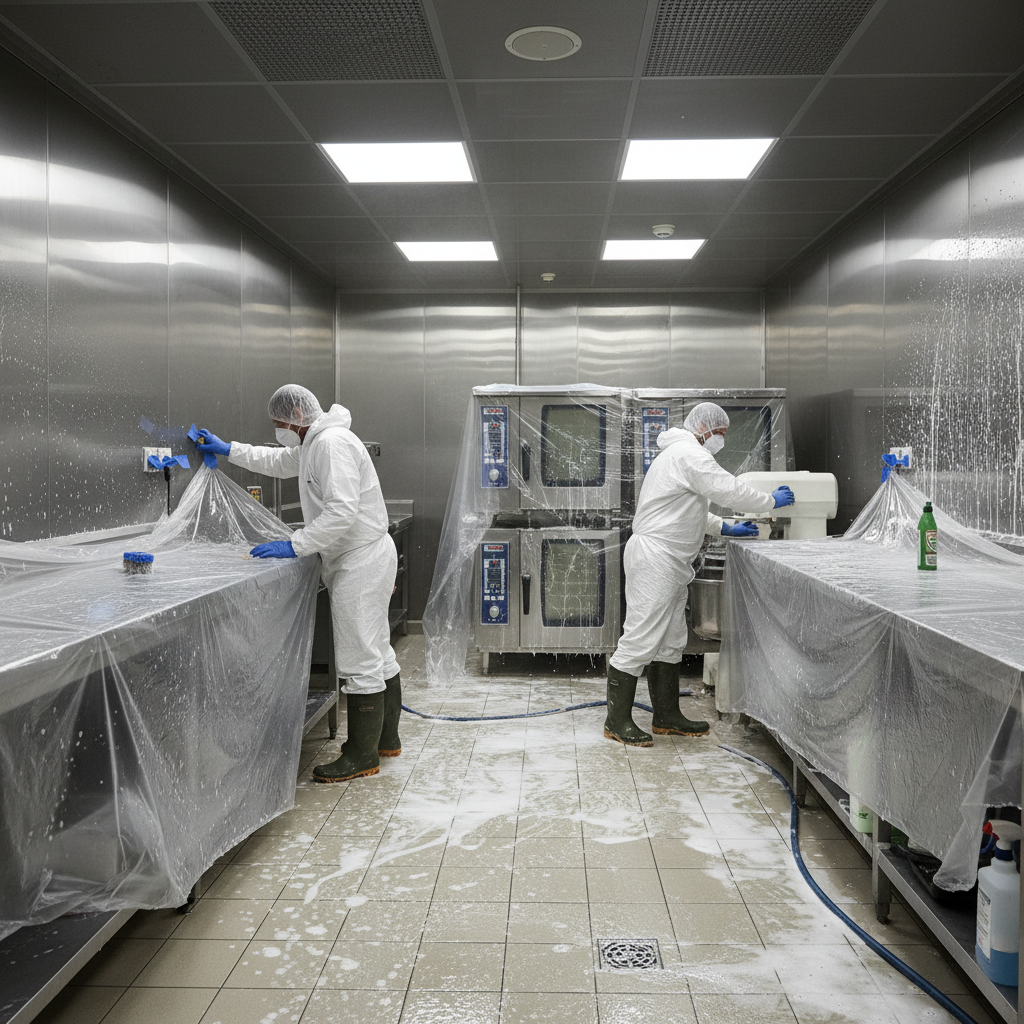
Wall floor ceiling cleaning requires acid washing and grease removal chemicals because standard degreasers cannot penetrate months of accumulated contamination on vertical and overhead surfaces.
Surface preparation and equipment protection. Technicians mask electrical outlets, cover equipment with protective sheeting, and remove loose debris. Wall surfaces get scraped to remove thick grease deposits before chemical application.
Chemical application and dwell time. Industrial degreasers get sprayed onto walls and ceilings using pressure applicators. Acid-based floor cleaners get applied to remove embedded grease and food particles. Chemicals need 15-30 minutes contact time for full penetration.
High-pressure washing and rinse cycles. Pressure washers remove dissolved grease and chemical residues. Multiple rinse cycles ensure no cleaning product remains on food contact surfaces. Steam cleaning follows for final sanitization.
Drying and surface protection. Industrial fans accelerate drying to prevent bacterial growth. Food-safe sealers get applied to porous surfaces to prevent future grease penetration.
Acid washing removes 85-95% of embedded grease vs 30-40% with standard degreasers because acid breaks down the molecular bonds that hold grease deposits to surface materials. Birmingham’s hard water requires adjusted chemical concentrations to prevent mineral deposits during the cleaning process.
When Should Birmingham Restaurants Schedule Deep Cleaning Services?

Pre-inspection deep clean prevents EHO violation notices because contaminated surfaces are the primary cause of food hygiene failures in Birmingham commercial kitchens.
Before EHO inspections or license renewals. Birmingham Environmental Health Officers schedule unannounced visits, but license renewals and complaint investigations give advance warning. Deep cleaning removes evidence of poor maintenance that triggers violation notices.
After pest control treatments or contamination incidents. Rodent infestations or food poisoning investigations require documented decontamination. Insurance claims demand proof that contamination sources were eliminated through professional deep cleaning.
Quarterly maintenance for high-volume kitchens. Restaurants serving 200+ covers per day accumulate contamination faster than weekly cleaning can remove. Quarterly deep cleaning maintains certification standards and prevents equipment breakdown from grease buildup.
New premises preparation and end-of-tenancy requirements. Taking over existing kitchen space requires documented deep cleaning to establish baseline hygiene standards. Lease agreements often specify professional cleaning before handover to prevent deposit disputes.
Birmingham EHO issues 73% fewer violation notices to kitchens with documented quarterly deep cleaning because regular professional maintenance prevents the contamination buildup that triggers inspection failures. The cost of prevention beats the cost of violation fines and forced closures.
What Hygiene Certifications Do Birmingham Deep Cleaning Companies Provide?

Hygiene certification documents deep cleaning completion and contamination removal through standardized testing and photographic evidence that satisfies EHO inspection requirements.
Certified deep cleaning contractors provide ATP (adenosine triphosphate) testing results that measure bacterial contamination levels before and after cleaning. Results below 30 RLU (Relative Light Units) demonstrate effective decontamination. Birmingham EHO accepts ATP certification as proof of hygiene compliance.
TR19 certificate standards apply when deep cleaning includes extraction system decontamination. BESA (Building Engineering Services Association) registered contractors can issue TR19 compliance certificates alongside general hygiene documentation. This dual certification covers both cooking equipment and ventilation systems in one process.
Insurance companies require photographic documentation showing contamination removal from high-risk areas. Certified contractors provide before-and-after images of equipment internals, wall surfaces, and floor areas to support insurance claims and demonstrate due diligence in hygiene maintenance.
Birmingham insurers accept hygiene certificates from 12 certified deep cleaning contractors who maintain BESA registration and public liability coverage. Certificate validity ranges from 6-12 months depending on kitchen volume and contamination risk factors.
Frequently Asked Questions
How long does a full commercial kitchen deep clean take?
A complete deep clean takes 8-16 hours for an average Birmingham restaurant kitchen. Equipment disassembly and reassembly account for 60% of the time, with surface decontamination and drying taking the remainder.
Can Birmingham restaurants stay open during deep cleaning?
No, commercial kitchens must shut down completely during deep cleaning due to chemical use and equipment disassembly. Most Birmingham operators schedule deep cleans on closure days or between service periods.
Do Birmingham takeaways need deep cleaning as often as full restaurants?
Takeaways need deep cleaning every 6 months vs quarterly for full restaurants due to higher volume and grease production. Birmingham EHO inspectors apply the same contamination standards regardless of operation type.