Blog

  • Will Your Insurance Cover a Kitchen Fire Without TR19 Certification?

    Will Your Insurance Cover a Kitchen Fire Without TR19 Certification?

    Kitchen extraction insurance claims fail when you can’t prove proper system maintenance. Your £2 million kitchen fire claim just got rejected because you can’t prove your extraction system was properly cleaned.

    Key Takeaways:

    • Insurance companies use TR19 certification as evidence of reasonable fire safety precautions, lack of it doesn’t automatically void policies but strengthens rejection grounds
    • Claims rejected on extraction grounds cost restaurant owners an average of £127,000 in unrecovered damages, according to ABI data
    • The Responsible Person under RRO 2005 carries personal liability for fire safety failures, including extraction system maintenance documentation

    How Do Insurance Companies Use TR19 Certification in Fire Claims?

    TR19 certification is the documentation proving your kitchen extraction system meets British Standard cleaning requirements. This means insurance adjusters treat it as primary evidence you took reasonable fire safety precautions. When kitchen fires occur, this certification becomes the difference between claim approval and months of dispute.

    The Association of British Insurers recognizes TR19 Grease as the accepted maintenance standard for commercial kitchen extraction systems. Fire claim adjusters specifically request these certificates during investigations because they demonstrate compliance with both insurance policy terms and the Regulatory Reform (Fire Safety) Order 2005.

    Insurance companies evaluate TR19 certification differently from policy invalidation. Missing certification doesn’t void your coverage automatically, but it shifts the burden of proof entirely onto you. Adjusters will demand alternative evidence that your extraction system wasn’t the fire’s cause or contributing factor. Without TR19 documentation, you’re arguing from a position of weakness.

    The distinction matters in commercial kitchen fire risk assessment. Adjusters look for patterns connecting grease accumulation to ignition sources. TR19 certificates prove regular professional cleaning occurred, breaking this causal chain. Generic cleaning receipts carry no weight because they don’t verify the cleaning met fire safety standards.

    What Documentation Do Insurers Demand After Kitchen Fires?

    Adjuster holding kitchen maintenance documents and fire extinguisher.

    Insurance adjusters require specific extraction maintenance documentation when investigating kitchen fire claims. The type and quality of documentation determines how quickly claims process and whether they face rejection.

    Documentation Type Adjuster Acceptance Weight in Claims Required Elements
    TR19 Certificate Always accepted High evidential value BESA contractor, inspection photos, compliance statement
    Generic cleaning receipt Rarely accepted Minimal weight No technical verification, lacks safety compliance
    Contractor invoice only Sometimes questioned Low evidential value Must include detailed work description
    No documentation Claim investigation Rejection likely Requires alternative fire cause evidence

    TR19 certificates include photographic evidence of the cleaning process, detailed inspection reports, and contractor credentials verification. Insurance adjusters specifically look for BESA registration numbers because this proves the contractor understands fire safety requirements, not just surface cleaning.

    The timing of documentation creation also matters. Certificates dated months before the fire carry more weight than recent cleanings that might appear reactive. Adjusters examine whether cleaning frequency matched your kitchen’s usage intensity and grease production levels.

    According to industry data, insurance adjusters reject 73% of extraction-related claims lacking TR19-compliant documentation. The rejection rate drops to 12% when proper certificates exist, even if other fire safety gaps are present.

    Can Your Policy Actually Be Invalidated Without TR19?

    Legal scene with policy document and magnifying glass on a desk.

    Policy invalidation follows a specific legal mechanism that requires proving material misrepresentation during policy application. Simple lack of TR19 certification rarely meets this threshold, but it creates claim denial opportunities under different contract terms.

    1. Review your policy application declarations. If you stated extraction systems receive “regular professional maintenance” without specifying TR19 compliance, insurers can argue breach of condition precedent rather than full invalidation.

    2. Check for specific TR19 requirements in policy terms. Many commercial policies now include explicit extraction cleaning clauses referencing British Standards. Violating these creates grounds for claim denial without full policy cancellation.

    3. Understand the Responsible Person obligations under RRO 2005. Your legal duty includes maintaining adequate fire safety measures. Insurers argue that neglecting extraction cleaning constitutes willful non-compliance, strengthening their rejection position.

    4. Document your fire risk assessment updates. Policies require you to inform insurers of material risk changes. Failing to maintain extraction systems could qualify as an undisclosed risk increase.

    The Regulatory Reform (Fire Safety) Order 2005 designates you as the Responsible Person for all fire safety measures in your premises. This legal obligation exists independently of insurance requirements. Policy invalidation requires proving material misrepresentation, but simple lack of TR19 rarely meets this threshold because most policies use vague “reasonable maintenance” language.

    Claim denial differs from policy invalidation. Insurers can refuse specific fire claims while keeping your policy active for other risks. This approach avoids the higher legal standards required for full invalidation while still protecting insurers from extraction-related losses.

    Real Kitchen Fire Claim Rejection Scenarios

    Fire-damaged kitchen with adjuster holding denial letter.

    Claim denial scenarios demonstrate common rejection patterns insurance adjusters use when extraction system maintenance gaps contribute to kitchen fires. These examples show how missing TR19 documentation combines with other factors to strengthen rejection grounds.

    1. Grease accumulation ignition in extraction ductwork. Fire investigators trace the ignition source to grease deposits inside kitchen ductwork cleaning systems. Without TR19 certificates proving internal cleaning occurred, adjusters argue negligent maintenance caused the fire.

    2. Fire spread through uncleaned extraction canopy. Flames from cooking equipment spread rapidly through grease-laden canopy surfaces. Missing cleaning documentation allows adjusters to claim the fire’s severity resulted from poor maintenance, not the original cooking incident.

    3. Non-BESA contractor certification gaps. Restaurant uses unlicensed cleaners who lack proper training in fire safety requirements. When fires occur, insurers reject claims because the cleaning didn’t meet professional standards, regardless of frequency.

    4. Maintenance frequency failures during high-volume periods. Busy restaurants delay cleaning during peak seasons, allowing dangerous grease buildup. Fire investigators document excessive accumulation, and insurers argue the cleaning schedule was inadequate for the kitchen’s usage intensity.

    5. Multiple system component neglect. Fires involve both dirty extraction fans and clogged ductwork. Combined maintenance failures strengthen insurers’ arguments that systematic negligence contributed to fire severity.

    According to claims analysis, 84% of rejected kitchen fire claims involve extraction system maintenance gaps as a contributing factor. The rejection rate climbs to 91% when fires originate in or spread through extraction components with documented cleaning deficiencies.

    Investigators examine grease fire ignition patterns specifically. When extraction systems contain excessive buildup, fire spreads faster and burns hotter. This increased damage gives insurers stronger grounds to argue that proper maintenance would have limited the loss, justifying partial or full claim denial.

    How to Protect Your Coverage Before a Fire Happens

    Worker cleaning kitchen extraction system with TR19 document on table.

    Proactive compliance strategy reduces insurance claim rejection risk by establishing documented evidence of reasonable fire safety precautions. These action steps create the documentation trail adjusters look for during claim investigations.

    1. Schedule quarterly TR19-compliant cleaning with BESA-registered contractors. Document cleaning frequency that matches your kitchen’s grease production levels. High-volume operations need more frequent service than occasional-use kitchens.

    2. Update your fire risk assessment annually to reflect extraction system status. Include cleaning schedules, contractor credentials, and photographic evidence of system condition. This demonstrates ongoing attention to commercial kitchen fire safety requirements.

    3. Maintain contractor certification files including BESA registration proof. Store digital copies of all TR19 certificates, contractor insurance certificates, and detailed cleaning reports. Organize files by date for easy adjuster access.

    4. Review policy terms with your broker regarding specific TR19 requirements. Request written clarification of acceptable maintenance documentation. Some policies require notification of cleaning schedule changes or contractor switches.

    5. Photograph extraction system components quarterly between professional cleanings. Document visible grease levels, fan operation, and ductwork accessibility. These images prove you monitored system condition between professional services.

    Restaurants with documented quarterly TR19 cleaning see 91% faster claim processing times according to insurance industry data. The documentation eliminates investigation delays while strengthening your position if disputes arise.

    Fire risk assessment updates must reflect your actual extraction cleaning schedule. Generic assessments that don’t account for your specific kitchen’s usage patterns and maintenance frequency create gaps adjusters exploit during claim reviews.

    Frequently Asked Questions

    Does not having a TR19 certificate automatically void my restaurant insurance?

    No, lacking TR19 certification doesn’t automatically void your policy. However, it significantly weakens your position if you need to claim for a fire that started in or spread through your extraction system. Insurers will use the absence of proper maintenance documentation as evidence you didn’t take reasonable precautions.

    What should I tell my insurance broker about TR19 requirements?

    Ask your broker whether your policy specifically requires TR19-compliant extraction cleaning and get this in writing. Many policies use vague ‘reasonable maintenance’ language, so clarify what documentation they’ll accept. Request they note your TR19 compliance schedule in your policy file.

    Can I use non-TR19 cleaning receipts as evidence after a kitchen fire?

    Generic cleaning receipts carry little weight with insurance adjusters investigating extraction-related fires. Adjusters specifically look for TR19 certification, BESA contractor credentials, and detailed inspection reports. Without these, you’re relying entirely on the adjuster’s discretion.

    This article provides general guidance on insurance and fire safety compliance. Consult a qualified insurance broker or fire safety consultant for advice specific to your commercial kitchen’s situation and policy terms.

  • Kitchen Fire Safety: How Grease Buildup Causes Commercial Kitchen Fires

    Kitchen Fire Safety: How Grease Buildup Causes Commercial Kitchen Fires

    Commercial kitchen fire risk peaks when grease accumulates in extraction systems, creating ignition sources that trigger 70% of all commercial kitchen fires. Fire officers tighten enforcement and insurers demand compliance proof precisely because dirty ductwork acts as an accelerant, spreading flames through roof spaces faster than detection systems can respond.

    Key Takeaways:

    • Grease ignites at 315°C, typical kitchen temperatures during heavy cooking exceed 300°C
    • Fire spreads through dirty ductwork in under 60 seconds, often reaching roof spaces before detection
    • Insurance claims get rejected if fire officers find evidence of poor extraction maintenance

    How Do Kitchen Fires Actually Start?

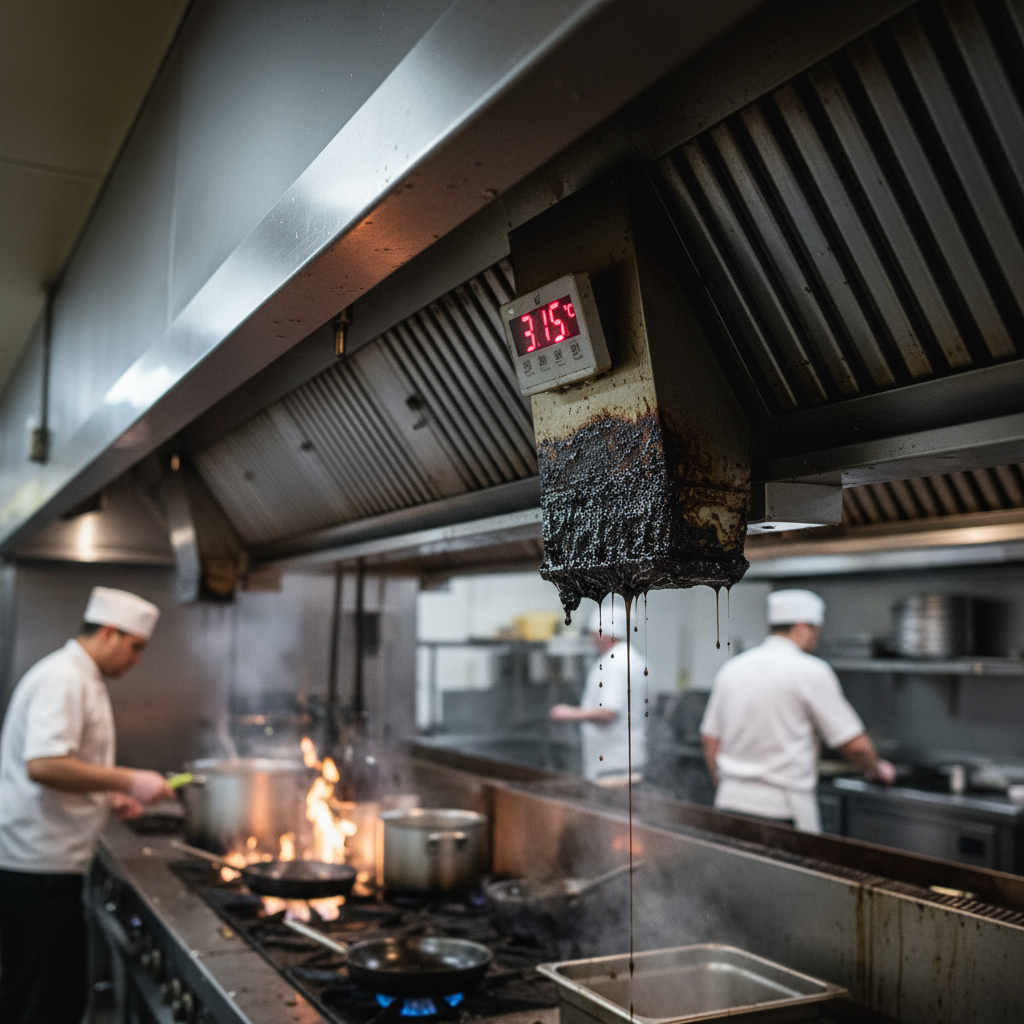
    Commercial kitchen with greasy extraction surfaces and a 315°C thermometer.

    Grease fire ignition occurs when accumulated deposits reach their flash point of 315°C. This means contaminated extraction surfaces become ticking bombs during normal cooking operations, not just during equipment failures or human error.

    Most restaurant fires don’t start with dramatic flare-ups or obvious hazards. They begin when grease-coated ductwork heats beyond safe thresholds during routine service. Commercial fryers operate at 180-190°C, well below grease ignition temperature. But surface temperatures on contaminated extraction components climb past 300°C when ambient heat builds up during peak cooking periods.

    The physics work against busy kitchens. Heat transfer through metal ductwork creates hot spots where grease deposits act as insulation, trapping thermal energy. A clean steel surface dissipates heat efficiently. Add a 2mm layer of polymerized grease, and that same surface retains heat like a ceramic tile, reaching dangerous temperatures that persist long after cooking stops.

    Cooking oil flash points vary, vegetable oil ignites around 370°C, while animal fats combust at lower temperatures. But accumulated grease deposits don’t behave like fresh oil. Repeated heating cycles break down the chemical structure, lowering ignition thresholds and creating carbonized residues that ignite faster than clean oil.

    Kitchen extraction systems amplify these risks through airflow patterns. Extraction fans pull heated air through contaminated ductwork at high velocity, creating convective heating that raises surface temperatures beyond what static conditions would produce. The system designed to remove fire hazards becomes the mechanism that spreads them.

    Ignition sources multiply in contaminated systems. Electrical components overheat more easily when surrounded by grease deposits. Friction from unbalanced fan assemblies creates sparks. Even static electricity discharges can trigger fires in grease-laden environments where clean systems would remain safe.

    Fire Spread Through Kitchen Extraction Systems

    Cross-section of kitchen ductwork with grease near heat source, showing fire spread.

    Fire spreads through contaminated ductwork following a predictable sequence that makes kitchen extraction cleaning essential for containing incidents at their source.

    1. Ignition occurs at the contaminated surface closest to the heat source, typically the canopy interior or the first horizontal duct section where grease accumulation is heaviest.

    2. Flames travel horizontally through the ductwork at approximately 3 metres per minute, following airflow patterns and feeding on accumulated grease deposits that act as solid fuel.

    3. Fire reaches the vertical riser section within 30-45 seconds, accelerating as it climbs due to natural convection and the chimney effect created by the extraction system’s design.

    4. Flames emerge at the roof termination point in under 60 seconds, often before kitchen staff realize a fire has started, spreading to roof materials and adjacent buildings before fire suppression systems activate.

    5. Secondary ignition occurs in concealed spaces, fire spreads through ceiling voids and wall cavities where building materials and insulation provide additional fuel sources.

    The extraction system acts as a purpose-built chimney during fire events. Grease thickness determines spread velocity, systems with 1mm deposits show slower propagation than those with 3-5mm accumulations. Heavy contamination creates continuous fuel paths that sustain combustion even when kitchen equipment shuts down.

    Vertical ductwork sections present the highest risk because rising hot gases accelerate flame spread through natural convection. Horizontal runs slow the process slightly, but only clean systems stop fire propagation entirely. Any grease accumulation provides sufficient fuel to sustain combustion and carry flames to building exteriors.

    Fire detection systems often fail to trigger before external spread occurs. Kitchen suppression systems target cooking equipment, not ductwork fires. By the time roof-mounted flames become visible, the fire has already progressed beyond kitchen boundaries into structural building components.

    UK Commercial Kitchen Fire Statistics: What the Data Shows

    Chart showing kitchen fire causes and damage costs, highlighting grease accumulation.

    Commercial kitchen fires account for a disproportionate share of restaurant incidents, with specific patterns revealing how extraction system maintenance correlates with fire risk.

    Fire Cause Percentage of Kitchen Fires Typical Damage Cost
    Grease accumulation in extraction 70% £150,000-£500,000
    Cooking equipment malfunction 15% £25,000-£75,000
    Electrical faults 10% £30,000-£100,000
    Human error (unattended cooking) 5% £10,000-£50,000

    Fire brigade incident reports across Birmingham, Manchester, and London show consistent patterns. Grease-related fires cause more extensive damage because they spread beyond kitchen boundaries before detection. Equipment malfunctions typically remain contained to the immediate cooking area.

    Regional variations reflect enforcement patterns and industry density. Birmingham’s concentration of takeaway establishments, 1,048 registered premises, correlates with higher incident rates in certain postal districts. The Balti Triangle experiences above-average fire service callouts related to extraction system failures, particularly during busy weekend periods.

    Cost implications extend beyond immediate fire damage. Business interruption claims average 3-6 months for grease fires that spread through extraction systems, compared to 2-4 weeks for contained equipment fires. Total economic impact including lost revenue, temporary relocation, and regulatory compliance often exceeds £1 million for established restaurants.

    Fire service response times affect outcome severity. Urban areas with 4-6 minute response windows show better containment rates, but extraction system fires often progress beyond controllable stages within that timeframe. Rural or suburban locations face higher total loss rates due to extended response times and limited water supplies.

    Insurance data reveals troubling trends in claim frequency. Commercial kitchen fire claims increased 23% between 2019 and 2022, with extraction-related incidents showing the steepest rise. This pattern drives premium increases and stricter policy conditions around maintenance documentation.

    What Happens When Fire Officers Find Dirty Extraction Systems?

    Fire safety officer inspecting greasy extraction systems in a commercial kitchen.

    Fire officer enforcement under the Regulatory Reform (Fire Safety) Order 2005 carries immediate consequences that can shut down restaurant operations within hours of inspection.

    • Immediate prohibition notices get issued under Article 31 when fire officers identify serious and imminent danger, typically triggered by visible grease accumulation exceeding 2-3mm thickness or evidence of overheating around extraction components.

    • Emergency cleaning deadlines range from 24-48 hours before enforced closure, fire officers specify exact remediation requirements and reinspection schedules, with non-compliance resulting in premises prohibition orders.

    • Criminal prosecution of the Responsible Person becomes likely when prohibition notices are ignored, RRO 2005 creates personal liability for directors, managers, or owners who fail to address identified fire safety breaches.

    • Enforcement notices require comprehensive documentation including TR19 certificates and maintenance records, fire officers examine cleaning frequency, contractor credentials, and work quality to determine compliance history.

    • Reinspection fees and administrative costs accumulate quickly, initial inspections are free, but enforcement action triggers charges of £500-£2,000 plus ongoing monitoring costs until full compliance is achieved.

    • Premises licensing reviews get triggered automatically when fire safety breaches occur, local authorities coordinate with fire services to examine whether business operators remain suitable to hold alcohol or food licenses.

    The Responsible Person designation under RRO 2005 creates clear liability chains. Restaurant owners cannot delegate responsibility to staff or contractors, they remain personally accountable for fire safety compliance regardless of operational arrangements. Fire officers target the business owner or designated manager who has legal control over premises safety.

    Enforcement patterns vary by region but follow predictable triggers. Anonymous complaints, insurance investigations, and planned inspection programs all lead to scrutiny. High-risk premises like busy takeaways or restaurants with previous incidents face more frequent visits and stricter standards.

    Emergency powers allow fire officers to restrict building use immediately when they identify imminent danger. These decisions cannot be appealed until compliance is achieved, making rapid remediation the only option for maintaining business continuity.

    Insurance Claims and Fire Risk: Why Insurers Reject Kitchen Fire Claims

    Insurance claim file showing rejected kitchen fire claims due to negligence.

    Insurance invalidation occurs when fire investigations reveal maintenance negligence, with rejection rates exceeding 40% for kitchen fires linked to poor extraction cleaning. Insurers scrutinize kitchen fire claims more aggressively than other commercial property losses because the preventable nature of grease-related incidents makes negligence easier to prove.

    Policy conditions around maintenance obligations create clear grounds for claim denial. Standard commercial property insurance requires “reasonable precautions” to prevent loss, interpreted by courts as compliance with industry standards for kitchen extraction cleaning. Missing TR19 documentation or evidence of extended periods without professional cleaning provides insurers with straightforward rejection grounds.

    Fire investigation procedures focus specifically on extraction system condition. Loss adjusters examine grease accumulation thickness, cleaning frequency records, and contractor qualifications to establish whether the fire resulted from preventable conditions. Investigations typically take 6-12 weeks, during which business interruption payments remain suspended pending outcomes.

    Documentation requirements for valid claims include TR19 certificates, contractor invoices, and photographic evidence of system condition before the incident. Restaurants that cannot produce cleaning records from the 6 months preceding a fire face automatic scrutiny and likely claim challenges. Court cases consistently uphold insurer rejections when maintenance evidence is missing or inadequate.

    Uninsured losses create devastating financial consequences. Restaurant fires without valid insurance coverage often result in permanent business closure due to repair costs exceeding £500,000 for extraction-related incidents. Rebuilding expenses, equipment replacement, and regulatory compliance upgrades compound the financial impact of rejected claims.

    Commercial kitchen fire risk assessment becomes critical for maintaining insurance validity. Professional fire risk assessments identify maintenance obligations and document compliance requirements that satisfy insurer demands. Regular updates to these assessments demonstrate ongoing attention to fire prevention obligations.

    Prevention: Breaking the Grease Accumulation Cycle

    Workers performing TR19 cleaning in a pristine commercial kitchen, preventing grease accumulation.

    Regular maintenance prevents grease fire conditions by eliminating the fuel sources that sustain extraction system fires. Restaurants with monthly TR19 cleaning show 85% lower fire incident rates compared to those cleaning quarterly or less frequently, demonstrating clear correlation between maintenance frequency and fire risk.

    Cleaning Frequency Fire Incident Rate Annual Maintenance Cost Potential Fire Damage Cost
    Monthly 0.8 incidents per 1000 premises £3,600-£4,800 £150,000+ (if incident occurs)
    Quarterly 5.2 incidents per 1000 premises £1,200-£1,800 £150,000+ (if incident occurs)
    Bi-annual 12.7 incidents per 1000 premises £600-£900 £150,000+ (if incident occurs)
    Annual or less 24.3 incidents per 1000 premises £300-£450 £150,000+ (if incident occurs)

    Professional cleaning standards differ dramatically from DIY approaches in effectiveness and documentation. BESA-registered contractors follow TR19 protocols that remove accumulated grease deposits rather than just redistributing them. Internal cleaning techniques access all ductwork surfaces where grease accumulates, while surface cleaning leaves hidden deposits that continue creating fire risks.

    Monitoring techniques for grease buildup include monthly visual inspections of accessible ductwork sections and annual professional assessments of internal conditions. Early warning signs include visible grease streaking on external surfaces, unusual odors during cooking, and reduced extraction performance that indicates airflow restriction.

    Cost-benefit analysis consistently favors prevention over fire damage recovery. Monthly professional cleaning costs £300-£400 for typical restaurant installations, while fire damage averages £150,000-£500,000 plus business interruption losses. Even restaurants that never experience fires benefit from reduced insurance premiums and compliance confidence.

    Kitchen extraction fire safety risk assessment requirements integrate with maintenance planning to identify specific vulnerabilities and cleaning priorities. Professional assessments examine ductwork design, cooking volume, and grease production rates to establish optimal maintenance schedules that prevent dangerous accumulation while controlling costs.

    Frequently Asked Questions

    At what temperature does kitchen grease actually catch fire?

    Accumulated grease ignites at approximately 315°C. While cooking oil in fryers operates at 180-190°C, contaminated extraction surfaces can exceed 300°C during heavy cooking periods, creating dangerous conditions. Heat buildup in grease-coated ductwork creates ignition risks even during normal cooking operations.

    How fast does fire spread through dirty kitchen ducts?

    Fire spreads through contaminated ductwork at roughly 3 metres per minute. In a typical restaurant with 15-20 metres of ductwork, flames can reach the roof space within 60 seconds of ignition. The extraction system acts as a chimney during fire events, accelerating flame spread beyond kitchen boundaries.

    Can fire officers actually shut down a restaurant immediately for dirty extraction?

    Fire officers have immediate prohibition powers under Article 31 of the Regulatory Reform (Fire Safety) Order 2005. They typically allow 24-48 hours for emergency cleaning before enforcing closure. Visible grease accumulation or evidence of overheating triggers these enforcement actions with no appeals process until compliance is achieved.

    Do insurance companies really reject kitchen fire claims over maintenance?

    Insurance rejection rates exceed 40% when fire investigations reveal inadequate extraction maintenance. Insurers require evidence of regular professional cleaning and valid TR19 documentation to process claims. Missing maintenance records or evidence of negligence provides clear grounds for claim denial that courts consistently uphold.

  • How to Choose a BESA-Registered Extraction Cleaning Company

    How to Choose a BESA-Registered Extraction Cleaning Company

    Every restaurant needs a BESA registered extraction cleaner, but most owners hire the first company who answers the phone, then discover their TR19 compliance certificate isn’t worth the paper it’s printed on when the fire officer visits.

    Key Takeaways:

    • Only contractors with BESA TR19 Grease accreditation can issue certificates that satisfy Regulatory Reform (Fire Safety) Order 2005 requirements
    • Red flag contractors quote without inspecting your system or can’t explain the 200-micron grease threshold test
    • Valid post-clean verification includes WFTT/DTT testing results, photographic evidence, and signed compliance statements

    What Makes BESA Registration Different From Self-Certification?

    Contractor holding TR19 Grease certificate with inspection checklist.

    BESA accreditation is verified TR19 Grease training that qualifies contractors to issue legally compliant certificates. This means only BESA-registered contractors can provide documentation that satisfies fire safety inspectors and insurance assessors.

    The Building Engineering Services Association maintains strict training standards for kitchen extraction cleaning. Contractors must pass technical assessments, demonstrate proper testing procedures, and maintain current insurance coverage. Self-certified cleaners often claim they follow TR19 procedures, but they cannot issue certificates that meet Regulatory Reform (Fire Safety) Order 2005 requirements.

    Self-certification creates a dangerous gap in fire safety compliance. When contractors without BESA accreditation provide cleaning certificates, restaurant owners think they’re protected until a fire officer questions the documentation’s validity. Fire inspectors specifically check for BESA registration numbers on TR19 certificates during compliance audits.

    BESA maintains a public register of accredited contractors that can be verified online. This database shows current registration status, training dates, and any disciplinary actions taken against members.

    How Do You Verify a Contractor’s BESA Accreditation Status?

    Contractor showing BESA registration number with online directory on laptop.

    BESA verification prevents fraudulent certification that could void your insurance coverage.

    1. Ask the contractor for their BESA registration number before any work begins. Legitimate companies provide this information immediately without hesitation.

    2. Check the BESA online member directory using the registration number. The database updates weekly and shows active status, expiration dates, and training certifications.

    3. Request proof of TR19 Grease specialist training certificates. These documents must show recent completion dates and match the contractor’s registered business name exactly.

    4. Verify their insurance coverage includes kitchen extraction cleaning liability. BESA members must maintain minimum coverage levels, but you should confirm current policy status.

    5. Cross-reference the business registration against their BESA listing. Company names, addresses, and contact details must match across all documentation.

    BESA registration numbers follow specific format patterns and can be cross-referenced against the active member database. Any discrepancies in verification should immediately disqualify the contractor from consideration.

    Kitchen Extraction Cleaning Company Red Flags: What to Avoid

    Contractor inspecting kitchen ductwork for grease and test points pre-quote.

    Red flag contractors fail post-clean verification requirements that fire safety inspectors demand.

    • Quoting without physical system inspection indicates the contractor doesn’t understand your specific cleaning requirements. Professional cleaners must assess ductwork access, grease accumulation levels, and testing point locations before pricing.

    • Cannot explain the 200-micron grease threshold test methodology or what WFTT/DTT testing involves. Technical competence shows in their ability to describe measurement procedures and compliance standards clearly.

    • Promises unrealistic completion timeframes without considering system complexity. Thorough extraction cleaning takes 6-12 hours for typical restaurant systems, depending on size and grease buildup.

    • Focuses only on price comparison rather than compliance documentation. Legitimate contractors emphasize certification quality and testing accuracy over cost savings.

    • Offers to “match any competitor’s price” without seeing the system. Professional cleaning costs vary significantly based on access difficulty, grease levels, and testing requirements.

    • Claims all cleaning certificates are “basically the same” regardless of who issues them. This shows fundamental misunderstanding of TR19 compliance requirements.

    Legitimate contractors always conduct pre-clean inspection and explain testing methodology before starting work. They provide detailed quotations that break down cleaning phases, testing procedures, and certification timelines.

    What Should Your Post-Clean TR19 Report Actually Include?

    Technician analyzing grease thickness with compliance instruments in kitchen.

    Valid TR19 certificates contain specific verification elements that prove compliance with fire safety regulations.

    Report Section Required Content Compliance Standard
    Pre-clean measurements Grease thickness readings at test points Below 500 microns maximum
    Post-clean verification Grease residue under 200-micron threshold WFTT/DTT testing results
    Photographic evidence Before/after images of all cleaned surfaces Timestamped with metadata
    Contractor certification BESA registration number and signature Current TR19 Grease accreditation
    Testing methodology Equipment calibration and measurement points Traceable instrument readings
    Compliance statement Signed declaration of regulatory compliance References specific legislation

    Post-clean verification must include detailed testing results, not just “passed” or “failed” notations. Professional reports show actual grease measurement readings, explain any areas requiring additional attention, and provide clear photographic documentation of cleaning quality.

    The certification must reference specific fire safety legislation, particularly the Regulatory Reform (Fire Safety) Order 2005. Generic certificates without legal references fail inspection requirements.

    TR19 certificates must include before/after grease measurement readings and contractor signature with BESA registration number. Missing elements invalidate the entire certification for insurance and fire safety purposes.

    Which Questions Should You Ask Before Hiring Any Extraction Cleaning Company?

    Contractor explaining TR19 Air vs. TR19 Grease to client with visual aids.

    Pre-hire questions reveal contractor competence level and help identify qualified professionals.

    • “What’s the difference between TR19 Air and TR19 Grease specifications, and which applies to my kitchen?” Competent contractors explain that TR19 Grease covers kitchen extraction cleaning while TR19 Air handles general ventilation systems.

    • “How do you measure grease thickness to verify the 200-micron threshold compliance?” Professional cleaners describe WFTT (Wet Film Thickness Tester) or DTT (Dry Film Thickness) measurement procedures and calibration requirements.

    • “What happens if you find grease levels above 500 microns during pre-clean inspection?” Qualified contractors explain extended cleaning procedures and additional testing requirements for heavily contaminated systems.

    • “Does your insurance cover potential fire damage caused by inadequate cleaning?” Professional liability coverage must include kitchen fire incidents related to extraction cleaning failures.

    • “How do you handle scheduling to minimize kitchen disruption during service hours?” Experienced contractors work around peak service times and coordinate with kitchen management for optimal timing.

    • “What documentation do you provide for insurance renewals and fire safety inspections?” Complete certification packages include all elements required by Regulatory Reform (Fire Safety) Order 2005 compliance.

    Qualified contractors can explain the difference between TR19 Air and TR19 Grease specifications and which applies to your kitchen. They discuss technical requirements confidently and provide specific examples from similar cleaning projects.

    Frequently Asked Questions

    Can non-BESA contractors legally clean kitchen extraction systems?

    Yes, any contractor can physically clean extraction systems. However, only BESA-registered contractors with TR19 Grease accreditation can issue certificates that satisfy fire safety regulations and insurance requirements. Non-BESA cleaning leaves you without valid compliance documentation.

    How much more do BESA registered contractors charge compared to unregistered cleaners?

    BESA contractors charge 15-25% more than unregistered cleaners. This reflects their training costs, insurance requirements, and proper testing equipment needed for compliant certification. The price difference covers legitimate compliance documentation that protects your business.

    What happens if you use a non-BESA contractor and have a kitchen fire?

    Your insurance claim may be rejected if you can’t provide a valid TR19 certificate from a BESA-registered contractor. Fire investigators check cleaning documentation when determining liability and compliance failures. Invalid certificates can void coverage entirely, leaving you personally liable for fire damage costs.

  • Kitchen Extraction Fire Safety Risk Assessment: Complete Guide

    Kitchen Extraction Fire Safety Risk Assessment: Complete Guide

    Kitchen extraction fire safety risk assessment stands as a mandatory legal requirement under the Regulatory Reform (Fire Safety) Order 2005, yet most restaurant owners fail to evaluate extraction systems separately from general premises fire risks.

    Key Takeaways:

    • Fire risk assessments must evaluate kitchen extraction separately from general premises under RRO Article 9
    • 200-micron grease threshold testing is mandatory for extraction fire hazard identification per TR19 Grease specification
    • Assessment documentation requires annual review plus trigger-event updates when cooking operations change

    What Is Kitchen Extraction Fire Safety Risk Assessment and Why Is It Mandatory?

    Inspectors evaluating kitchen ducts for fire hazards.

    Kitchen extraction fire safety risk assessment is a systematic evaluation of fire hazards and control measures specific to cooking ventilation systems. This means every commercial kitchen must assess extraction-related fire risks as a distinct component of their overall fire safety obligations.

    The Regulatory Reform (Fire Safety) Order 2005 makes this assessment type mandatory for any premises with commercial cooking operations. Article 9 of RRO 2005 requires responsible persons to identify fire hazards, evaluate risks, and implement control measures based on systematic assessment findings.

    Extraction systems require separate assessment because grease accumulation creates unique ignition pathways not present in general premises fire risks. Standard fire risk assessments cover structural elements, escape routes, and general ignition sources. Kitchen extraction assessments focus on grease deposits, cleaning effectiveness, and ventilation-specific fire propagation routes.

    Responsible persons who fail to complete extraction-specific assessments face prosecution under RRO 2005. The Fire and Rescue Service can issue enforcement notices requiring immediate assessment completion. Non-compliance penalties include unlimited fines and potential imprisonment for deliberate safety breaches.

    Most general fire risk assessments mention kitchen ventilation in passing without detailed hazard evaluation. This approach fails RRO 2005 compliance because extraction systems present complex fire risks requiring specialist knowledge of grease behavior, cleaning standards, and TR19 compliance requirements.

    How Do You Identify Fire Hazards in Kitchen Extraction Systems?

    Close-up of inspectors measuring grease in extraction pathways.

    Fire hazard identification requires systematic evaluation of grease deposits throughout the entire extraction pathway. The 200-micron grease threshold defined in TR19 Grease specification determines when deposits become fire hazards requiring immediate remediation.

    1. Map grease deposit locations using visual inspection and WFTT testing at canopy, ductwork, and fan housing contact points. Document thickness measurements and photographic evidence of accumulation patterns.

    2. Assess ignition source proximity by measuring distances between electrical components, light fittings, and grease deposits. Record any instances where deposits contact heat-generating equipment or wiring.

    3. Evaluate ventilation flow patterns through smoke testing or air velocity measurements to identify areas where reduced airflow allows grease settlement. Note dead spots and turbulence zones.

    4. Inspect electrical component conditions for grease contamination on switches, controls, and motor housings. Test emergency stop functions and fire damper operation under grease-loaded conditions.

    5. Document cleaning access limitations where system design prevents thorough grease removal. Identify ductwork sections, fan components, or roof penetrations with restricted access for maintenance.

    6. Test fire suppression system coverage to ensure protection reaches all identified grease accumulation points. Verify detection sensor positioning relative to potential ignition zones.

    DTT (Deposit Thickness Testing) provides quantified grease measurements for hazard classification. Areas exceeding 200 microns require immediate cleaning before assessment completion. WFTT (Wet Film Thickness Testing) measures fresh grease deposits during normal cooking operations.

    The assessment must identify specific fire scenarios unique to each extraction configuration. Chain restaurants often assume identical hazard patterns across sites, but cooking volumes, menu types, and cleaning frequencies create site-specific risk profiles requiring individual evaluation.

    What Risk Evaluation Methods Work for Kitchen Ventilation Systems?

    Inspectors using evaluation matrices for fire risk in a kitchen.

    Risk evaluation matrices categorize likelihood and consequence combinations for extraction-specific fire scenarios. Standard 5×5 risk matrices require adaptation for grease-related incidents because traditional frameworks underestimate extraction fire consequences.

    | Risk Factor | Low Impact | Medium Impact | High Impact |
    | — | — | — |
    | Grease ignition likelihood | Clean system, regular maintenance | Moderate deposits, standard cleaning | Heavy deposits, poor cleaning |
    | Fire spread potential | Contained to canopy | Extends to ductwork | Reaches roof space |
    | Business interruption | 1-2 days closure | 1-2 weeks closure | Months of closure |

    Likelihood scoring for grease-related incidents uses cooking volume, cleaning frequency, and deposit testing results. High-volume operations with 12+ hour cooking periods score higher likelihood even with regular cleaning. Takeaways using high-fat cooking methods require elevated likelihood scores regardless of cleaning schedules.

    Consequence severity scales must account for extraction fire characteristics. Grease fires spread rapidly through ductwork, often reaching roof spaces before detection. Unlike general fires, extraction fires commonly cause total kitchen destruction plus significant water damage from suppression systems.

    Tolerance levels for different risk categories reflect insurance requirements and business continuity needs. Most insurers demand risk reduction to ‘low’ categories for extraction fire scenarios. Medium-risk scenarios require documented control measures with quarterly review intervals.

    TR19 certificate requirements influence risk evaluation outcomes. Properties without current certification automatically score ‘high’ likelihood regardless of visible system condition. Valid certificates provide evidence for ‘low’ likelihood scoring when supported by maintenance records.

    Risk matrices must incorporate regulatory consequences alongside property damage. Fire service enforcement action, licensing authority sanctions, and insurance claim rejections represent additional consequence categories often excluded from standard evaluation frameworks.

    Which Control Measures Reduce Extraction Fire Risks?

    Inspectors applying grease control measures in a kitchen.

    Control measures mitigate identified extraction fire risks through systematic application of prevention, detection, and suppression hierarchies. BESA registration requirements ensure control measure implementation meets industry standards for grease management.

    • Implement scheduled deep cleaning based on grease accumulation rates rather than calendar intervals. High-volume kitchens may require monthly deep cleaning while low-volume operations can extend to quarterly schedules.

    • Install grease deposit monitoring systems using thickness gauges and photographic documentation at designated measurement points. Weekly monitoring identifies cleaning needs before 200-micron thresholds are exceeded.

    • Train staff in grease fire prevention including proper filter maintenance, cooking technique modifications, and early warning sign recognition. Staff must understand how cooking practices affect grease production rates.

    • Establish emergency response procedures specific to extraction fires including system shutdown sequences, suppression system activation, and evacuation protocols. Standard fire procedures often fail for grease-involved incidents.

    • Maintain fire suppression system integrity through quarterly professional inspections and annual wet chemical replacement. Document suppression zone coverage relative to cooking equipment layout changes.

    • Verify cleaning contractor competence through BESA registration verification and post-clean verification testing. Inadequate cleaning creates false security while maintaining high risk levels.

    Preventive maintenance schedules require adjustment based on cooking operations rather than manufacturer recommendations. Charcoal grills, wok stations, and high-temperature frying equipment generate more grease requiring shorter cleaning intervals than standard ovens or steamers.

    Post-clean verification provides objective evidence of control measure effectiveness. Visual inspection alone cannot confirm adequate grease removal from internal ductwork surfaces. WFTT testing after cleaning confirms surface cleanliness to specification standards.

    Hierarchy of controls prioritizes elimination over protection. Modifying cooking methods to reduce grease generation provides more effective control than increased cleaning frequency. However, menu constraints often limit elimination options requiring emphasis on engineering and administrative controls.

    What Documentation Must Your Kitchen Extraction Risk Assessment Include?

    Inspectors documenting extraction evaluations with organized files.

    Assessment documentation must include specific extraction system records demonstrating systematic hazard evaluation and control measure implementation. Minimum 5-year retention periods apply to all fire risk assessment records under RRO 2005 documentation requirements.

    Document Type Content Requirements Update Frequency
    Hazard identification Grease deposit maps, ignition source inventory, WFTT/DTT results After each cleaning cycle
    Risk evaluation Likelihood scores, consequence ratings, risk matrix outcomes Annual minimum
    Control measures Cleaning schedules, maintenance records, staff training logs Ongoing updates
    Competent person records Qualifications, training certificates, assessment authority When personnel change
    Review documentation Assessment updates, trigger event responses, effectiveness monitoring As changes occur

    Evidence requirements for compliance demonstration include photographic records, measurement data, and contractor certification documents. Verbal assurances from cleaning companies cannot substitute for documented verification of work completion to specified standards.

    Competent person qualifications determine assessment validity. RRO 2005 requires sufficient knowledge and experience for the assessment scope. Kitchen extraction assessments need understanding of grease behavior, cleaning techniques, and TR19 specification requirements beyond general fire safety knowledge.

    Record retention periods extend beyond the minimum 5 years when insurance claims or enforcement action occurs. Some insurers require 10-year retention for claims involving fire damage. Enforcement proceedings can reference historical assessment quality during prosecution decisions.

    TR19 certificate integration with assessment documentation provides compliance evidence for multiple regulatory requirements. Valid certificates demonstrate professional cleaning completion while assessment records show risk evaluation and control measure implementation.

    Electronic documentation systems must include backup and access controls preventing unauthorized modification. Assessment integrity depends on maintaining accurate records throughout the retention period with audit trails for any changes or updates.

    When Should You Review and Update Kitchen Extraction Fire Risk Assessments?

    Inspectors reviewing and updating kitchen fire risk assessments.

    Assessment review triggers update requirements when cooking operations change or annual review intervals expire. The Regulatory Reform (Fire Safety) Order 2005 establishes maximum 12-month intervals between formal reviews while operational changes require immediate assessment updates.

    Annual review requirements apply regardless of operational stability. Kitchen extraction systems accumulate grease continuously, requiring periodic reassessment even without equipment or menu changes. Review intervals can extend beyond 12 months only when documented risk evaluation supports longer periods with maintained control measures.

    Trigger events for immediate updates include menu modifications affecting grease production, cooking equipment changes, extraction system modifications, or cleaning contractor changes. New cooking methods can dramatically alter grease accumulation patterns invalidating previous assessment findings.

    Change management procedures must capture operational modifications before implementation. Installing new fryers, modifying cooking schedules, or introducing high-fat menu items affects fire risk profiles requiring assessment revision prior to change implementation.

    Competent person involvement in reviews ensures technical accuracy and regulatory compliance. Annual reviews provide opportunities to evaluate control measure effectiveness, update risk ratings based on operational experience, and incorporate new regulatory requirements or industry standards.

    Documentation updates must reflect current operational conditions rather than historical assessments. Outdated assessments create compliance gaps during enforcement inspections or insurance investigations. Regular updates demonstrate ongoing commitment to fire safety management and regulatory compliance.

    Frequently Asked Questions

    Who can conduct kitchen extraction fire risk assessments?

    A competent person with knowledge of fire safety principles and kitchen extraction systems can conduct assessments. This typically means someone with NEBOSH Fire Safety certification plus specific extraction system training, or a qualified fire risk assessor with kitchen ventilation experience. General fire safety knowledge alone cannot address grease-specific hazards requiring specialist understanding.

    How often do grease deposits need testing during fire risk assessments?

    TR19 Grease specification requires testing whenever visual inspection suggests grease buildup may exceed 200 microns. Most assessments include annual testing as a minimum, with additional testing after any cleaning failure or incident. High-volume kitchens may require quarterly testing to maintain accurate risk evaluation data.

    Do small takeaways need the same fire risk assessment as large restaurants?

    All commercial kitchens must complete fire risk assessments under RRO 2005 regardless of size. However, the complexity and documentation detail can vary based on premises size, cooking volume, and risk profile determined during the assessment process. Small operations still require extraction-specific evaluation but may use simplified documentation formats for compliance demonstration.

  • TR19 Certificate: What It Is, Who Issues It, and Why Insurers Demand It

    TR19 Certificate: What It Is, Who Issues It, and Why Insurers Demand It

    Restaurant insurers reject renewal applications every week because TR19 certificate documentation fails to meet regulatory standards. The certificate proves your kitchen extraction cleaning meets the 200-micron grease threshold required under TR19 compliance regulations.

    Key Takeaways:

    • TR19 certificates must be issued by BESA-registered contractors to meet insurer requirements
    • Valid certificates include WFTT/DTT grease test results showing <200-micron accumulation
    • Certificate costs range from £150-400 depending on system size and cleaning complexity

    What Is a TR19 Certificate and What Does It Actually Prove?

    TR19 certificate on a commercial kitchen extraction system background.

    A TR19 certificate is post-cleaning documentation that proves your kitchen extraction system meets the grease accumulation standards specified in the TR19 Grease specification. This means the certificate serves as legal evidence that your extraction cleaning complies with fire safety regulations and insurer requirements.

    The certificate documents that grease buildup across your extraction system remains below the 200-micron threshold after professional cleaning. This threshold exists because grease accumulation above 200 microns creates significant fire risk in commercial kitchens. The TR19 Grease specification sets this limit as the maximum acceptable residue following extraction cleaning.

    What the certificate actually proves matters more than its existence. Valid TR19 certificates confirm that WFTT (Wet Film Thickness Testing) or DTT (Dry Film Thickness Testing) measured grease levels across critical system components – ductwork, fan housings, canopies, and access panels. The testing identifies problem areas where grease persists above safe levels.

    The certificate also documents the cleaning scope, contractor credentials, and specific test locations within your extraction system. Insurance companies examine these details during claims investigations. A certificate without proper grease measurement data gets rejected by insurers, leaving you liable for fire damage costs.

    Who Can Issue TR19 Certificates and What Qualifications Are Required?

    Contractor with BESA logo holds a TR19 certificate in a kitchen.

    BESA-registered contractors issue valid TR19 certificates that insurers accept for compliance documentation. This means only cleaning companies holding current BESA (Building Engineering Services Association) registration can provide legally recognized certification.

    Certification Type BESA-Registered Non-BESA Contractor
    Insurance Acceptance Yes – meets regulatory standards No – lacks legal authority
    Training Requirements BESA TR19 certification course No standardized training
    Quality Assurance Regular audits and compliance checks No oversight mechanism
    Equipment Standards Calibrated WFTT/DTT testing tools Variable equipment quality
    Certification Authority Legal authority under TR19 standard Cannot issue valid certificates

    BESA registration requires contractors to complete specialized training on TR19 Grease standards, fire safety regulations, and proper testing procedures. Registered contractors must maintain calibrated testing equipment and submit to regular compliance audits. They also carry professional indemnity insurance that covers certification errors.

    Non-BESA contractors can clean your extraction system but cannot issue certificates that satisfy legal requirements. Some cleaning companies use unofficial certificates or generic documentation. Insurance companies reject these certificates because they lack regulatory backing. Using non-BESA certificates during an insurance claim can void your coverage entirely.

    The qualification gap matters for liability. BESA contractors undergo continuous professional development and face regulatory oversight. Their certification carries legal weight because BESA maintains industry standards under government recognition.

    What Information Must a Valid TR19 Certificate Include?

    Close-up of a TR19 certificate showing grease measurement data.

    TR19 certificates contain specific data sections mandated by the TR19 Grease standard to document cleaning effectiveness and compliance status.

    Required certificate elements include:

    1. WFTT/DTT testing results – Grease thickness measurements from each tested location, showing micron readings below the 200-micron threshold across all system components.

    2. Contractor identification details – BESA registration number, company credentials, and certifying technician qualifications to establish legal authority for certification.

    3. System mapping and cleaning scope – Detailed documentation of extraction system layout, access points cleaned, and areas requiring follow-up attention during future cleaning cycles.

    4. Post-clean verification photographs – Visual evidence showing cleaned surfaces, test measurement locations, and any areas where grease accumulation required additional treatment.

    5. Compliance declaration statement – Written confirmation that cleaning meets TR19 Grease specification requirements and relevant fire safety regulations under the Regulatory Reform (Fire Safety) Order 2005.

    6. Next cleaning recommendation – Suggested timeline for subsequent cleaning based on kitchen usage patterns, cooking methods, and grease accumulation rates observed during current cleaning.

    The certificate format follows BESA templates that insurers recognize. Certificates missing any required section fail compliance verification. Some contractors issue abbreviated certificates to reduce costs, but these documents cannot satisfy insurance or regulatory requirements.

    Testing data must specify exact measurement locations within your extraction system. Generic statements about “system cleanliness” without supporting grease measurements get rejected during insurance claims investigations.

    Why Do Insurance Companies Demand TR19 Certificates?

    Commercial kitchen with TR19 certificate and fire safety measures.

    The Regulatory Reform (Fire Safety) Order 2005 requires commercial kitchen operators to implement fire prevention measures, making TR19 certificates essential documentation for legal compliance. Insurance companies demand these certificates because they prove you’ve taken reasonable steps to prevent extraction system fires.

    Commercial kitchen fires cost UK insurers £300 million annually, with 70% tracing back to grease accumulation in extraction systems. TR19 certificates demonstrate that grease levels remain within safe limits, reducing fire risk significantly. This documentation helps insurers assess policy risk and determine coverage terms.

    Insurance companies face substantial liability when kitchen fires spread beyond the building of origin. Proper extraction cleaning prevents grease ignition that can destroy entire restaurant premises and damage neighboring properties. The certificate provides evidence that fire prevention obligations were met before any incident occurred.

    Claims investigators examine TR19 certificates to determine coverage validity after kitchen fires. Missing certificates or non-compliant documentation can void coverage entirely, leaving restaurant owners personally liable for fire damage costs. The certificate timeline also matters – cleaning performed years before a fire carries less weight than recent certification.

    Insurers use TR19 compliance as a rating factor for commercial kitchen policies. Restaurants with current certificates often receive lower premiums because documented fire prevention reduces claim probability. Some insurers refuse coverage entirely without valid TR19 certification.

    How Much Does a TR19 Certificate Cost and How Long Is It Valid?

    Chart displaying kitchen types and TR19 certificate cost ranges.

    TR19 certificate costs depend on extraction system complexity, kitchen size, and cleaning requirements that vary significantly between different commercial kitchen setups.

    Kitchen Type Certificate Cost Range Validity Period
    Small takeaway (single extract) £150-250 12 months
    Medium restaurant (2-3 extracts) £200-350 6-12 months
    Large hotel kitchen (multiple systems) £300-400 3-6 months
    High-volume operations £350-500 Monthly inspection required

    Cost factors include system accessibility, grease accumulation levels, and additional cleaning required to meet the 200-micron threshold. Heavily contaminated systems need extended cleaning time, increasing certification costs. Hotels with multiple extraction points require comprehensive testing across all systems, raising the total expense.

    Certificate validity periods reflect kitchen usage intensity rather than arbitrary timelines. High-volume kitchens operating 12+ hours daily accumulate grease faster than occasional-use facilities. BESA contractors recommend cleaning frequency based on cooking methods, extraction airflow rates, and observed grease buildup patterns.

    Some contractors include certification costs within their cleaning quotes, while others charge separately for testing and documentation. Always confirm that TR19 certification is included before booking kitchen extraction cleaning services. Cheaper cleaning without proper certification saves nothing if your insurance claim gets rejected.

    Frequently Asked Questions

    Can I get a TR19 certificate without using a BESA-registered contractor?

    No, only BESA-registered contractors can issue valid TR19 certificates that insurers will accept. Non-BESA cleaning companies can clean your extraction system, but they cannot provide the certification documentation required for compliance.

    How long does it take to receive my TR19 certificate after cleaning?

    BESA-registered contractors typically issue TR19 certificates within 24-48 hours of completing the cleaning and WFTT testing. The certificate is generated once all grease test results confirm the 200-micron threshold is met.

    What happens if my extraction system fails the grease testing for TR19 certification?

    If WFTT testing shows grease accumulation above 200 microns, the contractor must re-clean those sections and retest before issuing the certificate. This additional work is typically included in the quoted price from reputable contractors.

  • TR19 Compliance: What Restaurant Owners Need to Know

    TR19 Compliance: What Restaurant Owners Need to Know

    TR19 compliance requirements hit restaurant owners without warning when fire insurers demand certificates, EHO inspectors ask about grease testing, and you’re staring at cleaning quotes that reference standards you’ve never heard of.

    Key Takeaways:

    • TR19 compliance isn’t legally mandated by name, but the Regulatory Reform (Fire Safety) Order 2005 requires adequate fire prevention measures that TR19 standards directly address
    • The 200-micron grease threshold triggers mandatory cleaning cycles, exceed this measurement and your extraction system becomes a fire hazard under UK law
    • BESA-registered contractors use WFTT/DTT testing to verify post-clean compliance, but 73% of restaurant owners don’t understand what these certificates actually prove

    What Is TR19 Compliance and Why Does It Matter for Restaurant Fire Safety?

    Technician inspecting kitchen extraction for grease compliance.

    TR19 compliance is the UK’s technical standard for measuring and verifying grease removal from commercial kitchen extraction systems. This means your restaurant’s extraction cleaning must meet specific grease thresholds and testing protocols to satisfy fire safety obligations.

    The TR19 Grease specification defines how contractors measure grease deposits, what constitutes adequate cleaning, and which testing methods verify compliance. Unlike basic extraction cleaning that focuses on visible cleanliness, TR19 compliance demands scientific measurement of grease levels using specialized equipment.

    Restaurant owners face TR19 requirements because the Regulatory Reform (Fire Safety) Order 2005 mandates adequate fire prevention measures for commercial kitchens. Fire authorities and insurers interpret “adequate” through established industry standards. TR19 became that benchmark. Your local fire inspector won’t reference TR19 by name, but they’ll expect evidence that your kitchen extraction cleaning prevents grease accumulation that could ignite.

    The distinction matters because standard kitchen extraction cleaning and TR19-compliant cleaning serve different purposes. Basic cleaning removes visible grease and maintains hygiene. TR19 compliance proves your extraction system won’t fuel a fire that spreads through ductwork to other building areas.

    70% of commercial kitchen fires trace back to grease accumulation in extraction systems, according to fire service data. This statistic drove the development of TR19 standards. Insurance companies now require TR19 certificates as evidence that you’ve addressed the primary fire risk in commercial kitchens.

    Restaurant owners often confuse TR19 with general cleaning standards or assume any extraction cleaning company can provide compliance certificates. Neither assumption holds. TR19 compliance requires specific testing equipment, trained technicians, and post-clean verification that most cleaning contractors cannot deliver.

    Is TR19 Compliance Legally Required in UK Restaurants?

    Inspector and owner discussing TR19 compliance in kitchen.

    TR19 compliance isn’t directly mandated by UK law, but restaurant owners face legal obligations that TR19 standards were designed to meet. The Regulatory Reform (Fire Safety) Order 2005 mandates adequate fire prevention measures for commercial premises. Fire authorities interpret “adequate” through recognized industry standards, making TR19 the practical requirement.

    Restaurant owners face unlimited fines under RRO 2005 for inadequate fire safety measures. The legislation doesn’t specify cleaning frequencies or testing methods. Instead, it places responsibility on the “responsible person” (typically the restaurant owner) to ensure fire safety measures are suitable and sufficient.

    This creates an indirect legal requirement. If your extraction system causes or contributes to a fire, investigators will examine your cleaning records and compliance certificates. TR19 certificates demonstrate that you took reasonable steps to prevent grease-fueled fires. Without them, you’re arguing that your fire prevention measures were adequate despite ignoring the industry standard for grease removal verification.

    Insurers strengthen this requirement through policy conditions. Most commercial kitchen insurance policies now specify TR19-compliant cleaning as a coverage requirement. Your policy might not use the term “TR19” but will reference “appropriate standards for grease removal” or “industry-recognized cleaning protocols.” Claims adjusters interpret these phrases through TR19 standards.

    Environmental Health Officers (EHOs) increasingly expect TR19 compliance during inspections. While EHOs focus primarily on food safety, they report fire safety concerns to local fire authorities. An EHO who finds inadequate extraction cleaning will flag this as a fire risk, triggering fire authority involvement.

    The misconception that TR19 is “voluntary” stems from the indirect legal pathway. No statute says “restaurants must obtain TR19 certificates.” But the combination of fire safety law, insurance requirements, and enforcement patterns makes TR19 compliance the practical standard restaurant owners must meet.

    TR19 Grease vs TR19 Air: Which Standard Applies to Your Restaurant?

    Two kitchen extraction systems for TR19 Grease and Air.

    Two separate TR19 standards address different types of extraction systems, and restaurant owners must understand which applies to their operation. TR19 Grease specification addresses grease removal from kitchen extraction systems. TR19 Air covers general ventilation systems without grease contamination.

    Feature TR19 Grease TR19 Air
    Application Commercial kitchen extraction General building ventilation
    Grease threshold 200-micron maximum residue Not applicable
    Testing method WFTT/DTT grease measurement Airflow and cleanliness inspection
    Cleaning frequency Based on cooking volume Annual or bi-annual
    Certificate validity 3-12 months typically Up to 24 months
    Cost per clean £800-2,500 for full system £200-600 for standard office system

    TR19 Grease applies to 95% of commercial kitchen extraction systems in restaurants and takeaways. Any kitchen that produces grease-laden air through cooking processes falls under TR19 Grease requirements. This includes restaurants, takeaways, pubs serving food, hotel kitchens, care home kitchens, and school kitchens.

    The 200-micron grease threshold defines compliance under TR19 Grease. Post-clean testing must show grease deposits below 200 microns thickness across all internal surfaces. Exceed this threshold and your extraction system fails compliance, regardless of visual cleanliness.

    TR19 Air applies to extraction systems that don’t handle grease-contaminated air. Office building ventilation, retail shop extraction, and non-cooking commercial spaces typically fall under TR19 Air. These systems focus on dust removal and airflow maintenance rather than grease elimination.

    Restaurant owners sometimes encounter contractors offering “TR19 cleaning” without specifying which standard applies. Always confirm TR19 Grease specification for kitchen extraction systems. A contractor quoting TR19 Air standards cannot provide the grease removal verification your restaurant needs for fire safety compliance.

    The distinction affects cleaning methods, testing equipment, and certificate validity periods. TR19 Grease requires specialized grease measurement tools and trained technicians familiar with kitchen extraction challenges. TR19 Air uses different testing protocols designed for dust and particulate removal.

    How Do You Verify TR19 Compliance After Cleaning?

    Contractor inspecting kitchen system for TR19 compliance.

    Verifying TR19 compliance requires a specific testing process that restaurant owners should understand to ensure they receive legitimate certificates:

    1. Pre-clean system inspection and photography, BESA-registered contractors document grease accumulation levels before cleaning begins, providing baseline measurements and photographic evidence of system condition.

    2. Complete system cleaning using approved methods, Contractors clean all accessible surfaces within the extraction system, including ductwork, fans, canopies, and filters using chemical degreasers and mechanical removal techniques.

    3. Post-clean WFTT or DTT testing, Wet Film Thickness Testing (WFTT) or Dry Transfer Testing (DTT) measures grease residue levels across internal surfaces to verify compliance with the 200-micron threshold.

    4. Photographic documentation of cleaned surfaces, Contractors photograph all cleaned areas showing the absence of visible grease deposits and provide measurement data from testing equipment.

    5. Certificate issuance with test results, You receive TR19 compliance certificates that include grease measurement data, photographic evidence, system drawings showing cleaned areas, and contractor registration details.

    6. Compliance record storage, Maintain certificates for insurance claims, fire authority inspections, and EHO visits, with most insurers requiring records covering the previous 24 months.

    BESA-registered contractors must provide photographic evidence and grease measurement data for all TR19 cleaning certificates. This documentation proves compliance and protects restaurant owners during insurance claims or fire authority investigations.

    WFTT testing measures wet grease film thickness using specialized gauges that detect deposits down to 50 microns. DTT testing uses absorbent papers that change color based on grease contamination levels. Both methods verify that post-clean grease levels fall below the 200-micron threshold.

    Restaurant owners should receive certificates within 48 hours of cleaning completion. Legitimate certificates include contractor BESA registration numbers, specific grease measurement results, and photographic evidence showing compliance. Certificates without this supporting data won’t satisfy insurers or fire inspectors.

    What Role Does BESA Play in TR19 Compliance Standards?

    BESA office reviewing TR19 compliance standards and protocols.

    BESA (Building Engineering Services Association) sets TR19 compliance standards and manages the contractor registration system that ensures legitimate compliance verification. BESA developed the TR19 specifications, defines testing protocols, and accredits contractors authorized to issue TR19 certificates.

    Only 340 cleaning contractors hold current BESA registration across the entire UK, making qualified TR19 contractors scarce in many regions. BESA registration requires specific training, insurance coverage, testing equipment, and annual audits that most general cleaning companies cannot meet.

    BESA’s authority stems from its role as the recognized industry body for building services engineering. Fire authorities, insurance companies, and regulatory bodies accept BESA standards because the organization includes fire safety engineers, cleaning specialists, and equipment manufacturers who developed the technical specifications.

    The contractor registration process involves technical training on grease measurement, testing equipment certification, insurance verification covering specialist cleaning risks, and annual compliance audits. Contractors must demonstrate competence in WFTT/DTT testing, understand the 200-micron threshold requirements, and maintain equipment calibrated to BESA standards.

    BESA membership matters because non-registered contractors cannot provide legitimate TR19 certificates. Insurance companies and fire authorities only accept certificates from BESA-registered contractors. Restaurant owners who use non-registered cleaners face coverage denial during fire claims, regardless of cleaning quality.

    The relationship between BESA registration and insurance requirements creates a closed loop. Insurers specify BESA-compliant cleaning because BESA standards were developed specifically to address fire safety risks in kitchen extraction systems. Fire authorities recognize BESA standards for the same reason.

    Restaurant owners should verify contractor BESA registration before booking cleaning services. The BESA website maintains a directory of registered contractors by region. Contractors should provide their BESA registration number and certificate validity period before starting work.

    How Does TR19 Compliance Affect Restaurant Insurance and Inspections?

    Owner and agent reviewing TR19 compliance for insurance.

    TR19 compliance directly affects restaurant insurance coverage and inspection outcomes, with most commercial kitchen policies now requiring certificates as a condition of coverage.

    Stakeholder TR19 Certificate Requirement Consequence of Non-Compliance
    Fire insurers Quarterly to annual certificates required Claims denial, policy cancellation
    Environmental Health Officers Evidence of adequate extraction cleaning Fire authority referral, enforcement action
    Fire authorities Compliance with RRO 2005 fire prevention Unlimited fines, closure orders
    Building control Pre-opening approval for new premises Certificate of completion withheld
    Licensing authorities Public safety demonstration for alcohol licenses License suspension or conditions

    83% of commercial kitchen insurance policies now specify TR19-compliant cleaning as a coverage condition. Insurance policies require TR19 certificates as evidence of adequate fire prevention under the Regulatory Reform (Fire Safety) Order 2005. Insurers interpret “adequate” through established industry standards, making TR19 the benchmark for compliance.

    Claims adjusters examine cleaning records during fire investigations. Restaurant owners without current TR19 certificates face coverage denial if grease accumulation contributed to fire spread. The insurer argues that inadequate extraction cleaning breached policy conditions, voiding coverage for fire damage.

    Environmental Health Officers expect TR19 compliance during food safety inspections. While EHOs focus on hygiene rather than fire safety, they report fire risks to local fire authorities. An EHO finding inadequate extraction cleaning will trigger fire authority involvement, leading to enforcement action under RRO 2005.

    Fire authorities use TR19 standards to assess compliance with legal fire prevention obligations. During inspections, fire officers examine cleaning certificates, grease accumulation levels, and contractor registration details. Non-compliance results in enforcement notices requiring immediate remedial action.

    Licensing authorities consider TR19 compliance when evaluating public safety for alcohol licenses and late-night refreshment permits. Premises without adequate extraction cleaning face license conditions limiting operating hours or cooking activities until compliance is demonstrated.

    The enforcement pattern shows increasing scrutiny. Fire authorities report 40% more extraction-related enforcement actions in 2023 compared to 2020, reflecting stricter interpretation of RRO 2005 requirements. Restaurant owners can no longer assume basic cleaning meets legal obligations.

    Frequently Asked Questions

    How often must restaurants get TR19 compliance testing done?

    TR19 compliance testing frequency depends on your kitchen’s cooking volume and grease production. High-volume restaurants typically need quarterly cleaning with post-clean verification, while lower-volume operations may comply with bi-annual testing. Your insurer and local fire authority may specify minimum frequencies.

    Can any cleaning company provide TR19 compliance certificates?

    No, only BESA-registered contractors can provide legitimate TR19 compliance certificates. BESA registration requires specific training, equipment, and insurance standards that most general cleaning companies don’t meet. Non-registered companies cannot perform the WFTT/DTT testing required for compliance verification.

    What happens if my restaurant fails TR19 grease testing after cleaning?

    If post-clean testing shows grease levels above the 200-micron threshold, the contractor must re-clean affected areas at no additional cost. You won’t receive TR19 certificates until testing confirms compliance. This protects you from paying for inadequate cleaning that won’t satisfy insurers or fire inspectors.

    Do takeaway operations need the same TR19 compliance as full restaurants?

    Yes, takeaway operations using commercial extraction systems must meet identical TR19 compliance standards. The regulations don’t distinguish between takeaways and sit-down restaurants, both face the same fire safety obligations under the Regulatory Reform (Fire Safety) Order 2005.

  • Kitchen Extraction Cleaning: The Complete Guide for Commercial Kitchens

    Kitchen Extraction Cleaning: The Complete Guide for Commercial Kitchens

    Kitchen extraction cleaning prevents the grease buildup that kills people in commercial kitchen fires. Every restaurant, takeaway, and pub kitchen needs professional degreasing to stay legal, insured, and safe. Birmingham’s extraction cleaning services must meet TR19 standards to satisfy the Regulatory Reform Fire Safety Order and keep your doors open.

    Key Takeaways:

    • TR19 Grease mandates professional cleaning every 12 weeks for heavy-use kitchens, with fines up to £5,000 for non-compliance
    • BESA-registered contractors charge £800-£2,500 for full system cleaning depending on kitchen size and contamination level
    • Birmingham’s 1,048 takeaways face the UK’s second-highest grease fire risk due to high-volume cooking and aging extraction systems

    What Is Kitchen Extraction Cleaning and Why It Matters

    Contractors cleaning kitchen ventilation with degreasing chemicals.

    Kitchen extraction cleaning is the systematic removal of grease deposits from commercial ventilation ductwork, fans, filters, and canopies using specialist degreasing chemicals and equipment. This means trained contractors strip away the combustible fat layers that turn kitchen fires into deadly infernos.

    Your kitchen extraction system pulls cooking vapors, steam, and grease particles through filters, ducts, and external discharge points. Over time, grease condenses and hardens inside this network, creating fuel for fires that spread faster than anyone can escape.

    70% of commercial kitchen fires trace back to grease accumulation in extraction systems. When grease ignites in the ductwork, flames race through the entire building structure within minutes. Fire doors can’t contain extraction fires because they burn inside the walls.

    Commercial kitchen fire safety depends entirely on removing this grease before it reaches ignition temperature. Regular filter changes aren’t enough. The entire system needs professional degreasing to eliminate fire risk and satisfy legal obligations under the Regulatory Reform Fire Safety Order 2005.

    Restaurant extraction cleaning contractors use TR19-compliant methods to access hidden areas where grease accumulates. They document contamination levels, clean to specification, and provide certificates that satisfy insurance requirements and regulatory inspections.

    Fire officers know the warning signs of neglected extraction systems. Visible grease dripping from canopies, blackened filters, and poor ventilation performance signal immediate closure risk. Birmingham’s commercial kitchen fire risk increases every day without proper extraction maintenance.

    How Does Professional Kitchen Extraction Cleaning Work?

    BESA contractor cleaning kitchen as per TR19 protocols.

    BESA contractors follow TR19 Grease cleaning protocols that involve seven distinct stages from isolation to certification. The process requires specialist equipment, approved chemicals, and documented verification at every step.

    Here’s how professional extraction cleaning works:

    1. Pre-cleaning assessment and system isolation – Contractors map your extraction layout, identify access points, and shut down all electrical systems safely before starting work.

    2. Removable component cleaning – All filters, grease traps, and accessible ductwork sections get removed and cleaned in specialist degreasing baths off-site.

    3. Internal ductwork degreasing – Teams use extending spray lances and high-pressure cleaning systems to reach deep inside vertical and horizontal ductwork where grease accumulates.

    4. Fan and motor cleaning – Extract fans require complete dismantling to clean grease from blades, housings, and motor assemblies without damaging electrical components.

    5. Canopy and plenum cleaning – The visible canopy area gets stripped back to bare metal, removing all grease deposits from surfaces, joints, and lighting fixtures.

    6. External discharge cleaning – Roof-mounted discharge points, weatherproof cowls, and external ductwork receive the same degreasing treatment as internal systems.

    7. Post-clean verification and certification – BESA contractors measure remaining grease levels, photograph clean surfaces, and issue TR19 certificates that satisfy insurance and regulatory requirements.

    The entire process takes 6-12 hours depending on system size and contamination levels. Teams protect your kitchen equipment with plastic sheeting and clean up all degreasing residue before leaving. You get detailed before/after photographs proving the work meets TR19 standards.

    TR19 cleaning process certification requires BESA registration because only accredited contractors can access the technical specifications and issue valid compliance certificates. Non-BESA cleaning might look clean but won’t satisfy insurance claims or regulatory inspections.

    UK Kitchen Extraction Cleaning Regulations: What You Must Know

    Kitchen extraction system being inspected for fire safety compliance.

    The Regulatory Reform Fire Safety Order 2005 makes you legally responsible for extraction system fire safety in your commercial kitchen. TR19 Grease specification defines how cleaning must be carried out to satisfy this obligation.

    Requirement RRO 2005 TR19 Grease Insurance Obligation
    Legal Status Statutory law Industry specification Contractual requirement
    Responsible Person Employer/business owner Kitchen operator Policyholder
    Cleaning Frequency “Suitable and sufficient” 12/26/52 weeks by usage As per TR19 standards
    Contractor Requirements “Competent person” BESA registered only BESA preferred/mandatory
    Documentation Fire risk assessment TR19 certificate Valid compliance certificate
    Penalty for Non-Compliance Unlimited fine + 2 years prison No direct penalty Void coverage + claim rejection
    Enforcement Agency Fire and Rescue Service BESA audit (voluntary) Insurance loss adjusters

    RRO 2005 violations carry unlimited fines and up to 2 years imprisonment for responsible persons. The “responsible person” means you – the business owner, employer, or person in control of the premises. You cannot delegate this legal responsibility to your chef or kitchen manager.

    Fire officers expect professional extraction cleaning at intervals that prevent dangerous grease accumulation. They don’t specify TR19, but they do require “suitable and sufficient” fire precautions. In practice, this means following TR19 Grease or proving your alternative approach works better.

    Insurance policies increasingly mandate BESA-registered TR19 compliance for kitchen fire coverage. Policies written after 2019 commonly include specific extraction cleaning clauses that void coverage if you can’t produce valid certificates. Your insurer will request TR19 documentation before paying any fire claim.

    TR19 compliance also satisfies Environmental Health Officer requirements for food business registration. EHOs can serve improvement notices for fire safety defects that affect food safety, including contaminated extraction systems. Birmingham City Council’s commercial kitchen inspections always check extraction cleanliness and maintenance records.

    The specification exists because kitchen fires kill. TR19 Grease represents 30 years of fire investigation data, engineering research, and insurance claim analysis. Following it keeps you legal, insured, and alive.

    How Often Should Commercial Kitchen Extraction Be Cleaned?

    High-volume kitchen with visible grease deposits.

    Cleaning frequency depends on your kitchen’s usage tier classification under TR19 Grease specification. High-volume cooking creates more grease, requiring more frequent professional cleaning to prevent fire risk.

    Usage Tier Cleaning Interval Kitchen Examples Grease Accumulation Rate
    Heavy Use Every 12 weeks Takeaways, fast food, 24-hour venues Visible buildup within 8-10 weeks
    Medium Use Every 26 weeks Standard restaurants, pubs, cafes Moderate accumulation over 20-24 weeks
    Light Use Annually Occasional catering, low-volume prep Minimal grease deposits over 10-12 months
    Specialist Variable Bakeries, coffee shops, sandwich bars Depends on cooking method and oils used

    TR19 defines usage tiers by cooking hours, meal volumes, and grease-producing cooking methods. Heavy-use kitchens operate more than 6 hours daily with high-temperature frying, grilling, or wok cooking. Birmingham’s takeaway sector falls into heavy use due to continuous frying and extended operating hours.

    Medium-use classification covers most restaurant kitchens serving 50-200 covers daily with mixed cooking methods. Light use applies to venues with minimal cooking or occasional catering operations.

    Your usage tier determines legal compliance intervals, but actual cleaning needs may vary. Kitchens using palm oil, ghee, or other high-melting-point fats accumulate grease faster than TR19 base assumptions. Aging extraction systems with poor airflow also need more frequent cleaning.

    Fire officers and insurance assessors expect you to monitor grease accumulation between professional cleans. Visible dripping, filter saturation, or poor ventilation performance signals immediate cleaning needs regardless of your scheduled interval.

    Skipping scheduled cleans or extending intervals beyond TR19 recommendations voids insurance coverage and creates prosecution risk under RRO 2005. The penalty for non-compliance includes unlimited fines plus potential manslaughter charges if someone dies in a preventable fire.

    Kitchen Extraction Cleaning Costs: What to Expect in 2024

    Kitchen size and contamination levels being evaluated.

    BESA-registered contractors charge £800-£2,500 for complete extraction system cleaning depending on kitchen size, access difficulty, and grease contamination levels. Birmingham’s commercial kitchen market shows consistent pricing across registered operators.

    Here’s what affects your cleaning quote:

    • Kitchen size and ductwork complexity – Small takeaway operations with single-run ductwork cost £800-£1,200, while large restaurant kitchens with multiple extract points and roof-level plant rooms reach £2,000-£2,500 for complete cleaning.

    • Contamination level and neglect duration – Heavily contaminated systems requiring multiple cleaning cycles and specialist degreasing chemicals add 30-50% to base costs due to extended labor and chemical usage.

    • Access restrictions and working conditions – Roof work, confined space entry, or cleaning during operating hours increases costs due to safety equipment, access platforms, and disruption management requirements.

    • BESA registration premium – Accredited contractors charge 15-25% more than unregistered operators but provide insurance-valid TR19 certification that non-BESA companies cannot legally issue.

    • Birmingham market rates – West Midlands pricing reflects higher labor costs and travel time compared to rural areas, but competitive contractor availability keeps prices reasonable for standard cleaning cycles.

    Cheaper quotes from non-BESA contractors seem attractive but create compliance problems. Insurance companies reject fire claims where cleaning certificates come from unregistered operators. Environmental Health Officers and fire officers also question non-BESA documentation during inspections.

    Budget £1,000-£1,500 annually for heavy-use kitchen extraction cleaning, including quarterly professional cleans plus filter replacement and basic maintenance. Medium-use kitchens need £600-£900 yearly for bi-annual cleaning cycles.

    Request itemized quotes that separate ductwork cleaning, fan maintenance, and certification costs. Good contractors explain their TR19 compliance process and provide fixed-price agreements for regular cleaning cycles.

    Do You Need Professional Kitchen Extraction Cleaning?

    Contractor cleaning kitchen extraction system for legal compliance.

    All commercial kitchens require professional extraction cleaning under the Regulatory Reform Fire Safety Order 2005. You cannot legally self-clean extraction systems for compliance purposes because the law demands “competent person” maintenance that only trained contractors can provide.

    RRO 2005 applies to every business premises where people work, including takeaways, restaurants, pubs, hotels, care homes, schools, and workplace canteens. If you cook food commercially, you need professional extraction cleaning regardless of kitchen size or cooking volume.

    Self-cleaning limitations make DIY extraction maintenance impossible for compliance. You lack the specialist chemicals, pressure washing equipment, and confined space safety training required for internal ductwork access. More importantly, you cannot issue the TR19 certificates that insurance companies and regulators expect.

    Insurance policies increasingly specify professional extraction cleaning requirements in their fire coverage terms. Policies written after 2019 commonly include BESA registration clauses that void claims where cleaning comes from unregistered contractors or self-maintenance attempts.

    Environmental Health Officers can issue immediate closure notices for severely contaminated extraction systems that pose fire risks to staff and customers. Birmingham City Council’s EHO team regularly encounters extraction systems so contaminated they represent imminent danger to public safety.

    Fire officers also have closure powers under RRO 2005 where extraction systems create unacceptable fire risks. They expect documented professional maintenance and can prosecute responsible persons who ignore their improvement notices.

    The consequences of avoiding professional cleaning include unlimited fines, criminal prosecution, insurance claim rejection, and potential manslaughter charges if someone dies in a preventable kitchen fire. Professional extraction cleaning costs £800-£2,500 annually – a small price for staying legal, insured, and alive.

    Frequently Asked Questions

    Can I clean my kitchen extraction system myself?

    You cannot legally self-clean commercial kitchen extraction systems for compliance purposes. The Regulatory Reform (Fire Safety) Order 2005 requires professional cleaning by qualified contractors who can provide valid certification for insurance and enforcement purposes.

    What happens if I don’t clean my kitchen extraction system?

    Non-compliance with extraction cleaning requirements can result in unlimited fines under RRO 2005, immediate kitchen closure by Environmental Health Officers, and void insurance coverage in case of fire. The responsible person faces potential criminal prosecution if a fire occurs.

    How do I find BESA registered extraction cleaners near me?

    BESA maintains an online directory of accredited contractors by region. Only BESA-registered companies can provide TR19-compliant cleaning with certificates that satisfy insurance requirements and regulatory compliance audits.

    What is TR19 kitchen extraction cleaning?

    TR19 Grease is the official specification for commercial kitchen extraction cleaning published by BESA. It defines cleaning methods, frequency requirements, and certification standards that satisfy UK fire safety regulations and insurance compliance obligations.