Responsible person fire safety kitchen duties fall on whoever controls the premises under the Regulatory Reform Order 2005. Most restaurant owners think their landlord handles this, but getting it wrong can void your insurance after a kitchen fire.
Key Takeaways:
- The Responsible Person under RRO 2005 is whoever controls the premises, usually the business operator, not the building owner
- Shared buildings split responsibility based on control: tenants own their kitchen space, landlords own common areas like stairwells
- Personal liability extends to directors and partners, you can face unlimited fines and up to 2 years imprisonment for fire safety breaches
What Does the Regulatory Reform Order 2005 Say About Kitchen Fire Safety Responsibility?

The Responsible Person is whoever has control of the premises to any extent. This means practical day-to-day control, not just legal ownership. The Regulatory Reform (Fire Safety) Order 2005 makes this person legally accountable for fire safety across their controlled areas.
Article 3 of RRO 2005 defines the Responsible Person as the person with control of premises in connection with carrying on a trade, business or undertaking. For commercial kitchens, this is almost always the restaurant operator who runs the business, holds the lease, and makes decisions about the space.
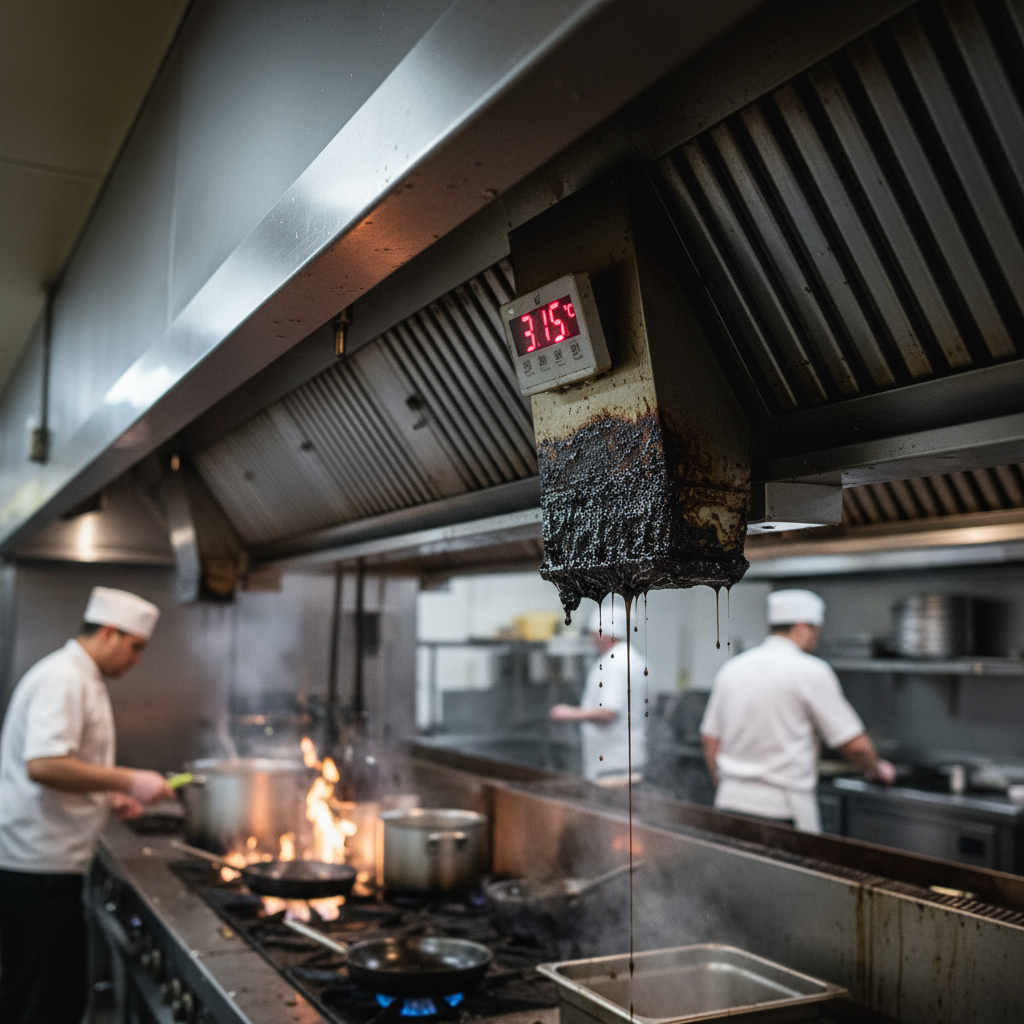
The Order places 14 specific duties on the Responsible Person through Articles 8-22. These include conducting fire risk assessments, implementing fire safety measures, maintaining equipment, and ensuring staff receive adequate training. Kitchen extraction systems fall directly under these requirements because grease accumulation creates the primary fire risk in commercial cooking spaces.
Control trumps ownership in this definition. If you run a restaurant in a rented building, you control that kitchen space. Your landlord may own the bricks and mortar, but you determine how the cooking equipment operates, when cleaning happens, and whether fire safety measures get maintained.
Who Controls Kitchen Fire Safety: Owner vs Tenant vs Managing Agent?

Control determines responsibility, and lease agreements often muddy these waters. The table below shows how different arrangements split fire safety duties for commercial kitchens:
| Arrangement | Kitchen Space Control | Common Areas Control | Fire Risk Assessment |
|---|---|---|---|
| Full Lease | Tenant (Restaurant Owner) | Landlord | Tenant for kitchen, Landlord for building |
| Shared Kitchen | Operating Business | Building Owner/Manager | Split based on actual control |
| Managed Property | Tenant (Day-to-day) | Managing Agent | Managing Agent coordinates |
| Sublease | Primary Tenant | Head Leaseholder | Primary Tenant |
Business operators who control kitchen operations bear responsibility for that space regardless of lease wording. You cannot contract out of RRO 2005 duties through clever lease clauses. Fire officers will identify the Responsible Person based on practical control, not what documents say.
Managing agents complicate this picture but follow the same control principle. If an agent makes fire safety decisions and controls access to premises, they become the Responsible Person. However, most agents limit their role to administrative tasks, leaving operational control with tenants.
Lease agreements should clarify boundaries, but they cannot override the statutory definition. Courts have consistently ruled that whoever exercises day-to-day control over premises operations holds responsibility under the RRO, regardless of contractual attempts to shift liability.
How Does Fire Safety Responsibility Split in Shared Commercial Buildings?

Shared buildings require clear boundary definitions between different Responsible Persons. Each area needs someone accountable for fire safety compliance.
Kitchen spaces belong to the operating business that controls cooking equipment, cleaning schedules, and staff training within that area.
Escape routes and corridors fall under landlord or building manager control because tenants cannot maintain areas they do not access or control.
Plant rooms and service areas typically remain with the building owner unless a tenant has exclusive access and operational control.
Shared dining areas in food courts or similar arrangements belong to whoever manages bookings, layout, and day-to-day operations in those spaces.
Storage areas belong to whoever holds the keys, controls access, and determines what gets stored inside.
Fire risk assessments must cover these boundary definitions explicitly. Each Responsible Person needs to understand exactly which areas fall under their control and coordinate with others to ensure no gaps exist in coverage.
Problems arise when multiple parties assume someone else handles shared areas. Birmingham fire officers regularly encounter buildings where escape routes, fire doors, or alarm systems fall through responsibility gaps because lease agreements lack clarity.
What Personal Liability Do Directors Face for Kitchen Fire Safety Breaches?

Directors and company officers face personal criminal liability under RRO 2005 that extends beyond their company’s limited liability protection. The process works through these escalating steps:
Fire officers identify breaches during inspections or after incidents, then serve improvement or prohibition notices on the company and named individuals.
Personal liability attaches to directors when breaches occur with their consent, connivance, or through their neglect under Article 23 of the Order.
Criminal charges follow for serious breaches, with unlimited fines and imprisonment terms up to 2 years for individuals, regardless of company structure.
Prosecution proceeds against both the company and individual directors simultaneously, meaning personal assets become vulnerable even if the business declares bankruptcy.
The courts interpret “neglect” broadly to include failures to establish proper systems, ignoring obvious risks, or delegating duties without adequate oversight. You cannot hide behind corporate structures when fire safety duties require personal attention.
Unlimited fines mean magistrates and crown courts can impose penalties matching the severity of consequences. Directors have faced six-figure personal fines for fire safety breaches that resulted in deaths or serious injuries.
When Does Kitchen Extraction System Failure Trigger Insurance Invalidation?

Insurance policies exclude coverage for claims arising from regulatory breaches, and extraction system failures often trigger these exclusions. Insurers use RRO 2005 compliance as a baseline for assessing whether fire damage claims deserve coverage.
Policies typically contain clauses voiding coverage when fires result from failure to maintain statutory fire safety standards. Kitchen extraction systems fall directly under these provisions because the Responsible Person must ensure fire safety measures remain effective.
Due diligence requirements include regular professional cleaning, maintenance records, and compliance certificates like TR19 documentation. Insurers will examine these records after any kitchen fire to determine whether the Responsible Person met their statutory duties.
Birmingham fire claims show a pattern where extraction system non-compliance leads to coverage disputes. Insurers argue that unclean ductwork, blocked filters, or missing maintenance records demonstrate regulatory breaches that void policy protection.
The burden of proof falls on the Responsible Person to demonstrate compliance at the time of any incident. Missing documentation or evidence of neglected extraction cleaning can invalidate an entire insurance claim, leaving business owners personally liable for fire damage costs.
Frequently Asked Questions
Can a restaurant owner delegate fire safety responsibility to their kitchen manager?
The Responsible Person under RRO 2005 cannot delegate legal responsibility, only operational tasks. If you control the premises, you remain legally liable even when delegating day-to-day fire safety management to staff members. You can assign tasks but not accountability.
What happens if both landlord and tenant think the other is responsible for kitchen fire safety?
Fire officers will identify the actual Responsible Person based on who controls the premises, regardless of what the lease says. Ambiguous lease terms do not excuse legal duties, the person with practical control bears responsibility. Confusion between parties does not create legal protection.
Does having a fire safety consultant remove my responsibility as the Responsible Person?
Consultants can help you meet your duties but cannot remove your legal responsibility. You remain the Responsible Person and face the same penalties if fire safety failures occur, even with professional advice. Expert help assists compliance but does not transfer liability.